
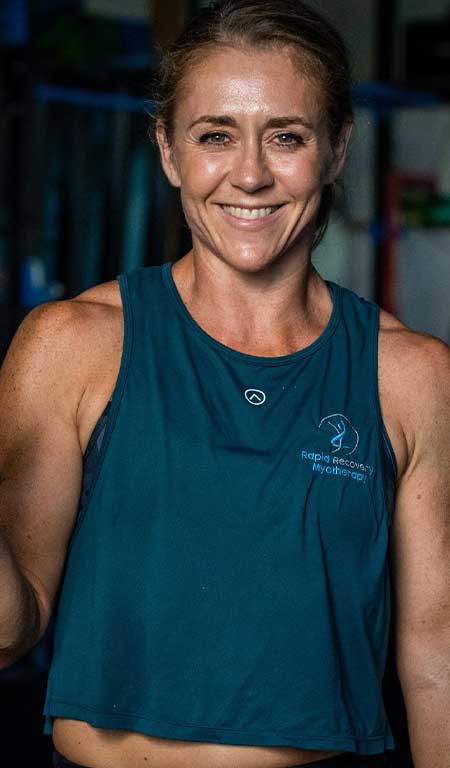

Meet Leanne
Dry Needling Information
Years Of Experience
Treatments
Personal Therapist
What Is Dry Needling? A Sunshine Coast Myotherapist Explains
I’m Leanne from Rapid Recovery Myotherapy in Buderim, and dry needling is probably the technique I get asked about most. People either want to know exactly what it is, or they’ve heard it works and they want to understand why. Either way, I want to give you a proper explanation, not a vague overview, because dry needling is one of the most clinically effective tools I use and it deserves more than a one-liner.
Dry Needling Is Not Acupuncture
This is the first thing I need to clear up because it comes up in almost every conversation. Dry needling and acupuncture both use fine needles but that’s where the similarity ends. Acupuncture is a traditional Chinese medicine practice based on energy meridians and the flow of qi through the body. Dry needling is a western, evidence-based clinical technique rooted entirely in musculoskeletal anatomy and neuroscience. The needle goes into a specific muscle, at a specific depth, targeting a specific structure, for a specific physiological reason. There is no energy theory involved. It is anatomy and science, applied precisely.
The term “dry” simply means the needle carries no substance. There is no injection, no medication, and nothing introduced into the tissue. The needle itself is the treatment.
How Dry Needling Actually Works
When a muscle is overloaded, injured, or chronically stressed, it can develop trigger points: hyperirritable, contracted nodules within the muscle fibre that generate local pain and refer sensation to other parts of the body. These points are real, palpable, and measurable. They don’t resolve with rest alone and they often don’t fully release with hands-on soft tissue work.
A fine filiform needle inserted directly into a trigger point causes a local twitch response in the muscle fibre. That twitch is the muscle releasing. Physiologically, what follows is a cascade of responses: a reduction in the concentration of inflammatory nociceptors around the point, a normalisation of the muscle’s resting tone, increased local circulation and oxygen delivery to the tissue, and a resetting of the neuromuscular signalling pathway that was maintaining the dysfunction.
In plain terms: the muscle lets go in a way that hands-on therapy sometimes can’t achieve on its own. For chronic, deep, or treatment-resistant pain, that makes dry needling genuinely powerful.
What Dry Needling Treats
I use dry needling across a wide range of musculoskeletal presentations. In my clinic on the Sunshine Coast it’s particularly effective for:
- Chronic lower back pain driven by trigger points in the quadratus lumborum, iliopsoas, and lumbar multifidus, particularly where the pain has persisted despite other treatment.
- Cervicogenic headaches and migraines originating from trigger point referral in the suboccipital muscles, upper trapezius, and sternocleidomastoid.
- Shoulder complex pain including rotator cuff dysfunction, supraspinatus trigger points, and posterior shoulder restriction limiting overhead mobility.
- Gluteal and hip pain from trigger points in the gluteus medius, piriformis, and tensor fasciae latae, commonly presenting as deep buttock pain or lateral hip ache.
- ITB syndrome and lateral knee pain in runners and cyclists where the TFL and gluteal complex are contributing to the load.
- Plantar fasciitis and Achilles tendinopathy where soleus and gastrocnemius trigger points are maintaining the load on the posterior chain.
- Thoracic spine restriction and mid-back pain from trigger points in the rhomboids, thoracic erectors, and serratus posterior.
- Jaw pain and TMJ dysfunction driven by masseter and pterygoid hypertonicity.
- Forearm and elbow pain in athletes and desk workers, including lateral epicondylalgia where the wrist extensor group is involved.
If you’ve been dealing with pain that has plateaued or that other therapies have only partially addressed, dry needling may be the missing piece.
What to Expect During a Dry Needling Session
I want to be honest with you about what dry needling feels like, because I think vague reassurances don’t help anyone make an informed decision.
The needle is extremely fine, significantly thinner than an injection needle, and insertion through the skin is usually barely perceptible. What you will feel, and what indicates the needle has found its target, is a local twitch response or a deep ache at the point of needling. That sensation can range from a brief dull heaviness to a momentary cramping feeling in the muscle. It passes quickly, usually within a few seconds, and most of my clients describe it as intense but tolerable.
After treatment the area may feel sore for 24 to 48 hours, similar to the feeling after a hard training session. This is normal and expected. It reflects the tissue responding to treatment. Most clients notice a significant reduction in their pain and an improvement in movement within one to three days following a session.
I always explain what I’m doing before I do it, which muscles I’m targeting and why, and what you’re likely to feel. You are in control of the session at every point.
Dry Needling for CrossFit Athletes and Active People
As a CrossFit athlete myself, I understand what it means to have a niggle that’s affecting your training but isn’t quite bad enough to stop you completely. You push through, it gets worse, and eventually what started as a minor restriction becomes something that actually pulls you out of the gym.
Dry needling is one of the most effective tools I have for keeping active people training. It works quickly, the effects are often felt within days, and it addresses the neuromuscular dysfunction driving the problem rather than just managing the symptoms. I use it regularly with CrossFit athletes, runners, and gym-goers across the Sunshine Coast who need their body to respond fast because their training schedule doesn’t have room for a six-week rehab timeline.
Common presentations I treat with dry needling in the active population include shoulder impingement limiting overhead pressing and pull-ups, hip flexor restriction affecting squat depth and running mechanics, posterior chain trigger points contributing to lower back pain under load, and calf and foot complaints that don’t resolve with stretching and rolling alone.
Dry Needling as Part of a Complete Treatment
Dry needling is not a standalone treatment in my clinic. It’s one tool within a broader session that also draws on myotherapy, remedial massage, and cupping depending on what your body needs. I use it when the clinical picture tells me it’s the right call: when trigger points are deep, when hands-on release hasn’t achieved sufficient change, or when the speed of response matters.
After needling I’ll always follow up with soft tissue work to the surrounding area, passive stretching, and where appropriate, corrective exercise to address the movement pattern that’s been loading the tissue. The needle gets the muscle to let go. The work that follows keeps it that way.
Is Dry Needling Safe?
Yes, when performed by a qualified practitioner with appropriate training. I hold an Advanced Diploma of Myotherapy and am registered with the Australian Natural Therapists Association (ANTA). Dry needling is performed using single-use, sterile needles that are disposed of immediately after each session. The risk of adverse events with a qualified practitioner is very low. Minor post-treatment soreness and occasional small bruising at the needle site are the most common responses.
I do not perform dry needling in areas where it is contraindicated, including over sites of local infection, on clients with certain bleeding disorders or on anticoagulant medication, or in the first trimester of pregnancy. We discuss your full health history before any treatment begins.
Private Health Rebates and Booking
Dry needling delivered within a myotherapy or remedial massage session is rebatable through most private health funds via HICAPS. I process your rebate on the day. Sessions are available in 30, 45, 60, and 90-minute durations, and for most presentations involving dry needling I recommend a minimum of 45 minutes to allow adequate assessment and treatment time.
I work from my home-based clinic in Buderim and see clients from across the Sunshine Coast including Maroochydore, Mooloolaba, Caloundra, Coolum, and Noosa. Online booking is available and I’d love to help you get on top of what’s been holding you back.
Find Our Studio
Location
4 Icarus Court, Buderim QLD 4556