
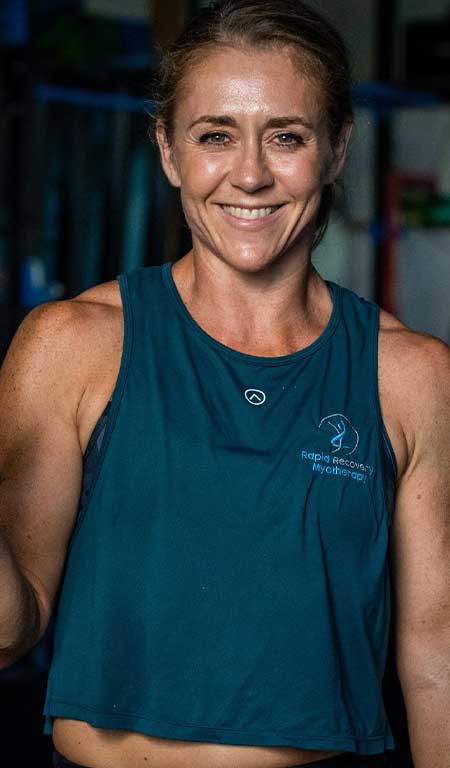
Meet Leanne
Myofascial Cupping Information
Years Of Experience
Treatments
Personal Therapist
What Is Myofascial Cupping? A Sunshine Coast Myotherapist Explains
I’m Leanne from Rapid Recovery Myotherapy in Buderim, and cupping is the therapy that tends to get the most curious reactions from new clients. People have seen the circular marks on athletes at the Olympics, they’ve heard it mentioned alongside recovery and performance, and they want to know whether it actually does anything or whether it’s just an aesthetic trend. Let me give you the real answer, because cupping has a legitimate clinical application and when it’s used correctly, it’s one of the most effective soft tissue tools I have.
Myofascial Cupping Is Not Traditional Cupping
The cupping I use in my clinic is myofascial cupping, and it’s worth distinguishing it from the traditional fire cupping associated with Chinese medicine. Traditional cupping uses heat to create suction in glass cups and is applied within a traditional medicine framework. Myofascial cupping uses modern silicone or mechanical cups to create controlled negative pressure in specific soft tissue targets, guided entirely by western musculoskeletal anatomy and fascial science.
Like dry needling, myofascial cupping sits within an evidence-based clinical framework. The application is anatomically precise, the mechanism is physiologically grounded, and the outcomes I’m working toward are specific and measurable. It is not a wellness ritual. It is a soft tissue therapy with a clear mechanism of action.
How Myofascial Cupping Actually Works
Most manual therapies work by applying compressive force to soft tissue: pressing, kneading, and working into the muscle from the outside in. Cupping does the opposite. By applying negative pressure through suction, the cup lifts the tissue upward, decompressing the layers of fascia, muscle, and skin rather than compressing them.
This decompressive effect does several things simultaneously. It creates separation between the fascial layers that may have become adhered following injury, chronic overuse, or prolonged postural loading. It increases local blood flow and lymphatic drainage to tissue that may be congested or poorly perfused. It stimulates mechanoreceptors in the fascial tissue, influencing the nervous system’s perception of tension and pain in the area. And it creates a sustained tensile load through the myofascial system that promotes tissue remodelling in areas of chronic restriction.
The result is a release of fascial adhesions and a reduction in tissue density that can be difficult to achieve through compression-based techniques alone. For areas of the body where the fascia has become genuinely thickened and bound down, cupping gives me access to a dimension of tissue that hands-on work doesn’t always reach.
What Myofascial Cupping Treats
Cupping is particularly well suited to presentations involving fascial restriction, tissue congestion, and areas of chronic tension that have become dense and resistant to conventional soft tissue work. In my Sunshine Coast clinic I use it regularly for:
- Thoracolumbar fascia restriction, one of the most common contributors to chronic lower back pain and stiffness, where the broad fascial sheet spanning the lower back and sacrum has become thickened and restricted.
- Upper back and thoracic spine tension, including rhomboid and mid-trapezius congestion that contributes to postural fatigue, interscapular pain, and restricted thoracic rotation.
- ITB and lateral thigh restriction in runners, cyclists, and CrossFit athletes where the iliotibial band and the underlying vastus lateralis have developed dense fascial adhesions contributing to lateral knee pain and hip tightness.
- Posterior shoulder and rotator cuff restriction where the posterior capsule and infraspinatus have become tight and congested, limiting internal rotation and contributing to shoulder impingement.
- Calf and posterior leg restriction including gastrocnemius and soleus fascial tightness contributing to Achilles tendinopathy, plantar fasciitis, and posterior knee pain.
- Hip flexor and quadriceps restriction in people with high training loads or prolonged sitting, where the rectus femoris and iliacus have shortened and the overlying fascia has thickened.
- Cervical and upper trapezius tension where chronic neck tightness and restricted cervical rotation have created dense, congested tissue that is slow to respond to hands-on work alone.
Static and Dynamic Cupping: Two Different Applications
There are two ways I apply cups in a session and the choice between them depends on what I’m trying to achieve.
Static Cupping
Places the cups on the tissue and leaves them in position for a sustained period. This creates a prolonged decompressive load through the fascia, allowing the tissue to release gradually under the sustained negative pressure. It’s particularly effective for areas of deep fascial restriction and chronic tissue congestion where I want to create a slow, sustained change in tissue quality.
Dynamic Cupping
Applies the cups and then moves them across the tissue while the suction is maintained. This combines the decompressive lift of the cup with a gliding traction through the fascial layer, effectively performing a myofascial release with a negative pressure tool. It’s highly effective for broad areas of restriction, improving tissue mobility and targeting the interface between fascial layers where adhesions are limiting movement.
In most sessions I’ll use a combination of both, starting with dynamic work to mobilise the tissue and then applying static cups to specific areas requiring deeper sustained release.
What the Marks Actually Are
The circular discolourations that cupping leaves on the skin are probably its most recognisable feature and also the most misunderstood. They are not bruises in the conventional sense. A bruise results from trauma that ruptures blood vessels. The marks from cupping result from the negative pressure drawing stagnant blood, metabolic waste, and interstitial fluid from the deeper tissue layers toward the surface, where the lymphatic and circulatory system can clear it more efficiently.
The colour of the marks tells me something about the tissue I’ve been working on. Darker marks indicate a greater concentration of stagnant fluid and congestion in the tissue. Areas with good circulation and healthy tissue typically produce little to no discolouration. In my experience, clients who present with dense, congested tissue in a specific area often see darker marks there on the first treatment, with the marks becoming progressively lighter in subsequent sessions as the tissue quality improves.
The marks are not painful to touch and typically fade within three to seven days.
Cupping for Athletes and Active People
As a CrossFit athlete I use cupping on myself as part of my own recovery, so when I recommend it to my clients I’m drawing on personal experience as well as clinical practice. For people under high training loads, cupping is a genuinely effective recovery tool.
High-volume training creates tissue congestion, fascial densification, and a cumulative restriction in the myofascial system that builds over time. Regular cupping helps clear that congestion, maintain tissue extensibility, and keep the fascial layers mobile and well-perfused. I use it with CrossFit athletes, runners, and gym-goers across the Sunshine Coast who want to maintain the tissue quality their training demands of them, and who have learned that passive rest alone doesn’t address the fascial component of recovery.
It’s also highly effective for athletes returning from injury, where fascial adhesions have formed around the injury site and are now limiting full movement restoration and contributing to compensatory loading patterns elsewhere in the body.
Cupping as Part of a Complete Session
Like all the tools I use, cupping doesn’t exist in isolation in my clinic. It’s one component within a session that draws on myotherapy, remedial massage, and dry needling in whatever combination your body needs. I typically use cupping in the middle portion of a session, after I’ve conducted my assessment and begun working the tissue with hands-on techniques, and before I complete the session with targeted soft tissue work, stretching, and exercise advice.
The combination of compression-based soft tissue work and decompressive cupping within the same session gives me access to the full three-dimensional quality of the tissue in a way that either technique alone doesn’t achieve.
Is Cupping Safe?
Yes, when applied by a qualified practitioner who understands the relevant anatomy and contraindications. I hold an Advanced Diploma of Myotherapy and am registered with the Australian Natural Therapists Association (ANTA). Cupping is a low-risk therapy when applied appropriately.
I do not apply cups over broken or inflamed skin, areas of active infection, varicose veins, bony prominences, or directly over the spine. Cupping is also contraindicated in clients with certain bleeding disorders or on anticoagulant medication, and is applied with care during pregnancy. We discuss your full health history before treatment begins and I will always explain where I’m applying cups and why before I do so.
Private Health Rebates and Booking
Myofascial cupping delivered within a myotherapy or remedial massage session is rebatable through most private health funds via HICAPS. I process your rebate on the day. Sessions are available in 30, 45, 60, and 90-minute durations. For sessions incorporating cupping alongside other techniques I recommend a minimum of 45 minutes.
I work from my home-based clinic in Buderim and see clients from across the Sunshine Coast including Maroochydore, Mooloolaba, Caloundra, Coolum, and Noosa. Online booking is available and I’d love to help you get your tissue moving the way it should.
Find Our Studio
Location
4 Icarus Court, Buderim QLD 4556